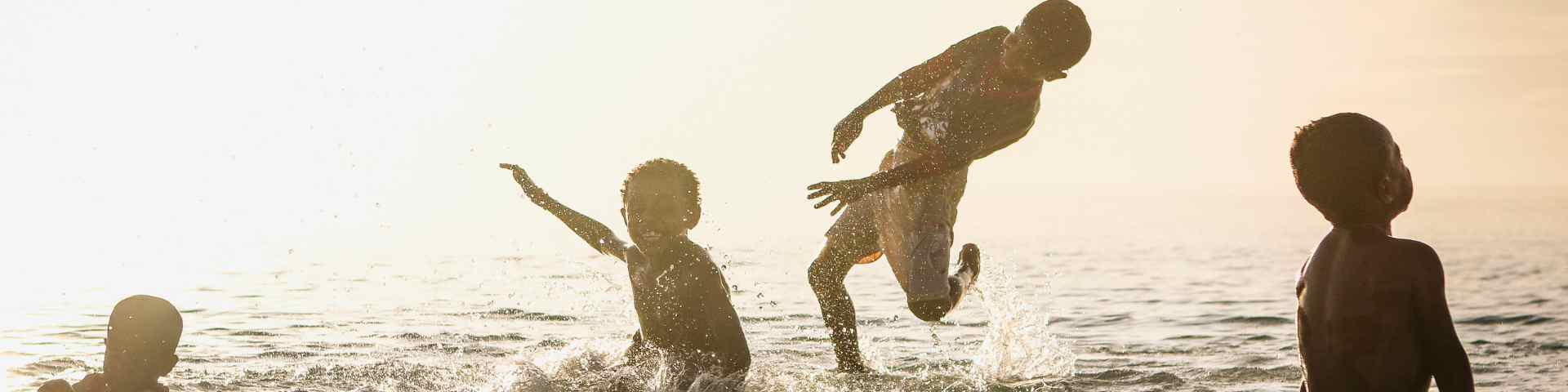
There is a quiet belief many of us inherit without ever questioning it: that life is serious, that our value is measured by how much we accomplish, and that play belongs to childhood—a phase we are meant to outgrow. At some point, often gradually, we begin to live as if everything depends on our performance. There are responsibilities to carry, bills to pay, children to raise, parents to care for, expectations to meet. The rhythm of life tightens. Time becomes something to manage, optimize, and justify. And in that tightening, something subtle begins to disappear.
Play. Not the structured kind, not the kind with a goal or outcome—but the simple, unguarded state of being where nothing needs to be achieved.
For many adults, play starts to feel almost inappropriate. Even wasteful. There can be a quiet guilt attached to it, as though time spent in ease is time stolen from something more important. This is especially true for those who were raised with the message that life is hard, that one must work relentlessly, that rest and lightness are luxuries rather than necessities.
But this belief, however common, comes at a cost. It creates tension—not only in the body, but in the way we relate to life itself. Everything becomes charged with importance. Every task carries weight. Every outcome feels like it matters too much. And slowly, almost without noticing, we become rigid. We lose flexibility, spontaneity, and the ability to simply be.
If you observe children, or even animals, you see a completely different orientation toward life. A child does not play to achieve something. A dog does not chase a ball with an agenda. There is no concern about productivity, no calculation about whether the moment is being used efficiently.
There is only presence. Play, in its truest form, anchors us in the present moment. When you are genuinely playing—whether that means moving your body, laughing, creating something, or simply resting in a state of ease—your mind is no longer pulled into the past with its regrets and unresolved emotions. Nor is it projecting itself into the future with its worries and imagined scenarios. It settles. And in that settling, something important becomes possible.
The body relaxes. The nervous system softens. The constant inner pressure eases. And from this state, a different kind of intelligence begins to emerge—quieter, clearer, more intuitive. Many people try to solve their problems from a place of tension. They push harder, think more, analyze longer, as if effort alone will break through the wall they are facing. But often, the opposite is true. The more force we apply from a contracted state, the more resistance we encounter.

There are moments in life when nothing seems to work. When solutions feel out of reach, when everything we try only seems to complicate things further. These are the moments that test our instinct to control. And yet, there is another way.
Instead of pushing harder, one can step away. Not in avoidance, but in trust. To pause, to release the urgency, and to enter a state of play—not as an escape, but as a return to balance. For some, play might look like gardening—hands in the soil, attention absorbed in something simple and alive. For others, it might be a walk in nature, where the mind begins to quiet without effort. It can be reading, music, movement, or even sitting in stillness without the need to do anything at all.
These are not trivial activities. They are restorative states. In such moments, we are no longer forcing life to respond to us. We are allowing ourselves to come back into alignment with it.
From a spiritual perspective, this shift matters deeply. When the mind is tense and preoccupied, it becomes difficult to access intuition—the subtle inner guidance that does not shout, but quietly directs. But when we are relaxed, open, and present, that connection becomes much clearer. It is not in stress that we hear ourselves most truthfully. It is in ease.
There is also a deeper layer to this. Playfulness requires a certain surrender. It asks us to release control, even if only briefly. To accept that not everything needs to be managed, fixed, or predicted. To allow for the possibility that things may not unfold as we expect—and to be at peace with that. This is not indifference. It is a form of trust.
To say, inwardly: I will do what I can, but I will not destroy my inner state trying to force an outcome. Paradoxically, it is often from this place of acceptance that clarity arises. Solutions appear more naturally. Decisions feel less strained. Life begins to move again, not because we have controlled it into place, but because we have stopped resisting it.
To reclaim playfulness in adulthood is not to abandon responsibility. It is to carry responsibility differently—with less tension, less fear, and less attachment to results. It is also to reconnect with a part of ourselves that has never truly disappeared, only been neglected. That childlike presence—the one that knows how to be curious, light, and engaged without pressure—is still there. It does not demand much. Only attention.
And perhaps even more than a right, play is something closer to an obligation—not in the sense of duty, but in the sense of care. A responsibility toward your own inner balance. Because a life lived entirely in seriousness becomes heavy. But a life that makes space for play becomes more fluid, more resilient, and, in a quiet way, more whole. You are allowed to step out of the constant effort.
You are allowed to soften. And you are allowed—fully—to play. So go ahead, even now—choose something small, something simple, something that brings a quiet sense of lightness… and let yourself step into it.
About the Author:
Marianna oversees the daily operations of The Dr. Wanda Pratnicka Center, skillfully advising staff members on guiding clients through the spirit removal process. Her efforts extend beyond management; she is dedicated to raising awareness about the phenomenon of spirit possession, utilizing various platforms including events, books, and digital media. In her leisure time, Marianna delights in gardening, immerses herself in reading, and explores new natural wonders.
Stay tuned for enlightening new blog posts EVERY SUNDAY - your weekly dose of inspiration and guidance.
----
ADDITIONAL RESOURCES:
1. You can find more information about common symptoms of spirit attachment / possession here:
2. How to check whether you or your loved one are experiencing a spirit attachment?
3. Want to learn more about how we remove spirits?

April 4, 2026
Load more
We offer FREE CONSULTATION.
Simply give us a call.
The Dr. Wanda Pratnicka Center
4602 21st Street PO BOX 1285
New York, NY 11101
Disclaimer: Our services are not intended to replace allopathic medicine, but rather to complement it. We do not prescribe any medications and/or medical treatments nor interfere with prescribed medications and/or medical treatments. The Dr. Wanda Pratnicka Center, nor any of its members, is not responsible for any individual's failure to seek proper medical attention.
If you are in a crisis or any other person may be in danger - don't use this site. These resources can provide you with immediate help.
Copyright © 2025 by The Dr. Wanda Pratnicka Foundation, All rights reserved














 US
US 